





I'm Cazzy—a data scientist, hands-on systems builder and CEO of  . My work follows a practical question: how do we keep intelligence useful, accountable and under meaningful human control as it moves through the world?
My starting point was laboratory quality control. It left me with a useful habit: ask what a result can actually support before deciding what to do with it. That question still follows me into data science, AI governance and the things I build.
Consequential AI keeps the human stakes in view. My interest in sovereign systems is concrete: who controls a deployment, what it depends on, and what remains possible when a connection or an assumption fails.


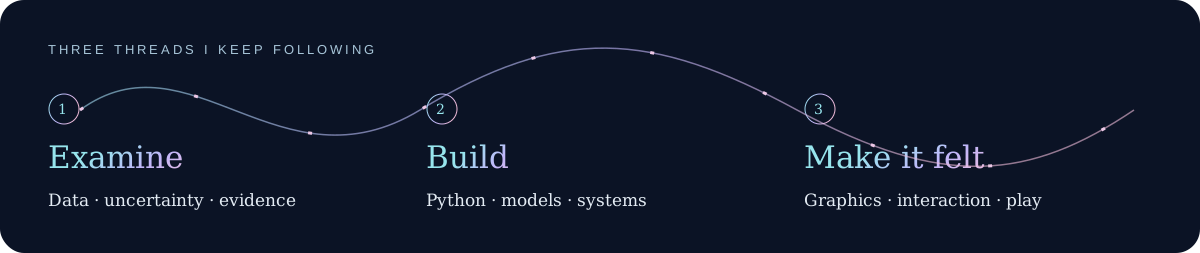
| A question I follow | A public place to explore it |
|---|---|
| What happens when requests arrive together—or events arrive late? | Rate-limiting algorithms and stream-processing experiments: Python, asynchronous execution, windows and state. |
| Can another person retrace the result? | Velvet Python — Python experiments with data validation and dataset signatures, alongside tests. |
| What changes when different signals meet? | Multimodal AI experiments — PyTorch attention, bilinear and Tucker fusion, and graph operations. Mathematics expressed as inspectable implementations. |
| What happens when a plausible answer travels? | AI hallucination analysis — a notebook exploring documented legal hallucination cases, missing data and patterns over time. |
| Can a picture make a difficult idea easier to question? | Pretty Vizuals — scientific and exploratory graphics, with Python, Matplotlib, Plotly and geospatial work. |
These are public studies and experiments, with different scopes and levels of maturity. The source and its limitations are part of the work.
A small question before you go: what does an average leave out?
For these twelve invented values, the mean is 6:
2, 3, 4, 4, 5, 5, 5, 6, 6, 7, 8, 17
The arithmetic is correct. The value 17 is still there. A useful summary and a complete account are different things.

Python is the main thread, with JavaScript, HTML/CSS and SVG for interactive work. Across the repositories: PyTorch models, statistical exploration, asynchronous systems, scientific visualization and 3D studies. I’m interested in how these choices behave together, not just how each looks in isolation.
Education & earlier work
- MS, Data Science — University of Denver.
- BS, Integrative Biology; Chemistry minor — Oregon State University.
- AI in Healthcare certificate — Johns Hopkins University, 2025.
- Earlier work spans laboratory quality control and data science leadership.
- Oscar Humberto Montemayor Award — Oregon State University, 2022.
A few timestamps in the work
- October 2025: multimodal fusion implementations, followed by stream-processing and rate-limiting examples.
- July 2026: Python learning systems and evidence tooling.
A few points in the public history; the repositories keep the detail.

At , I bring these interests into one longer undertaking: research and software for a world where technical decisions have human consequences. A global system meets local lives. Governance starts with understanding who is affected, who can challenge a decision, and what evidence survives a change. That is a design responsibility as much as a research question.
There is room for delight, too. Ouchii Mori is our upcoming little world of monsters, small steps and large feelings. Absolutely no obligation to be normal.


Company · Public worlds · Personal notebook · LinkedIn · Start a conversation
An interesting question is a perfectly good introduction.