Repository navigation
Home
This page is published from the repository. Edit it there: docs/wiki/index.md.
Eight.ly Agent is a single Go binary that turns any Docker host into a managed node for Eight.ly OS. Deploy the agent on Linux, macOS, or Windows, point EOS at it, and get full container management, WebSocket console, file browsing, and system monitoring — all over authenticated TLS.
About 4,800 lines of Go. Five dependencies. Zero config files.
One Go binary. Apache 2.0 license. Hardened through security review. The newest release is on the Releases page.
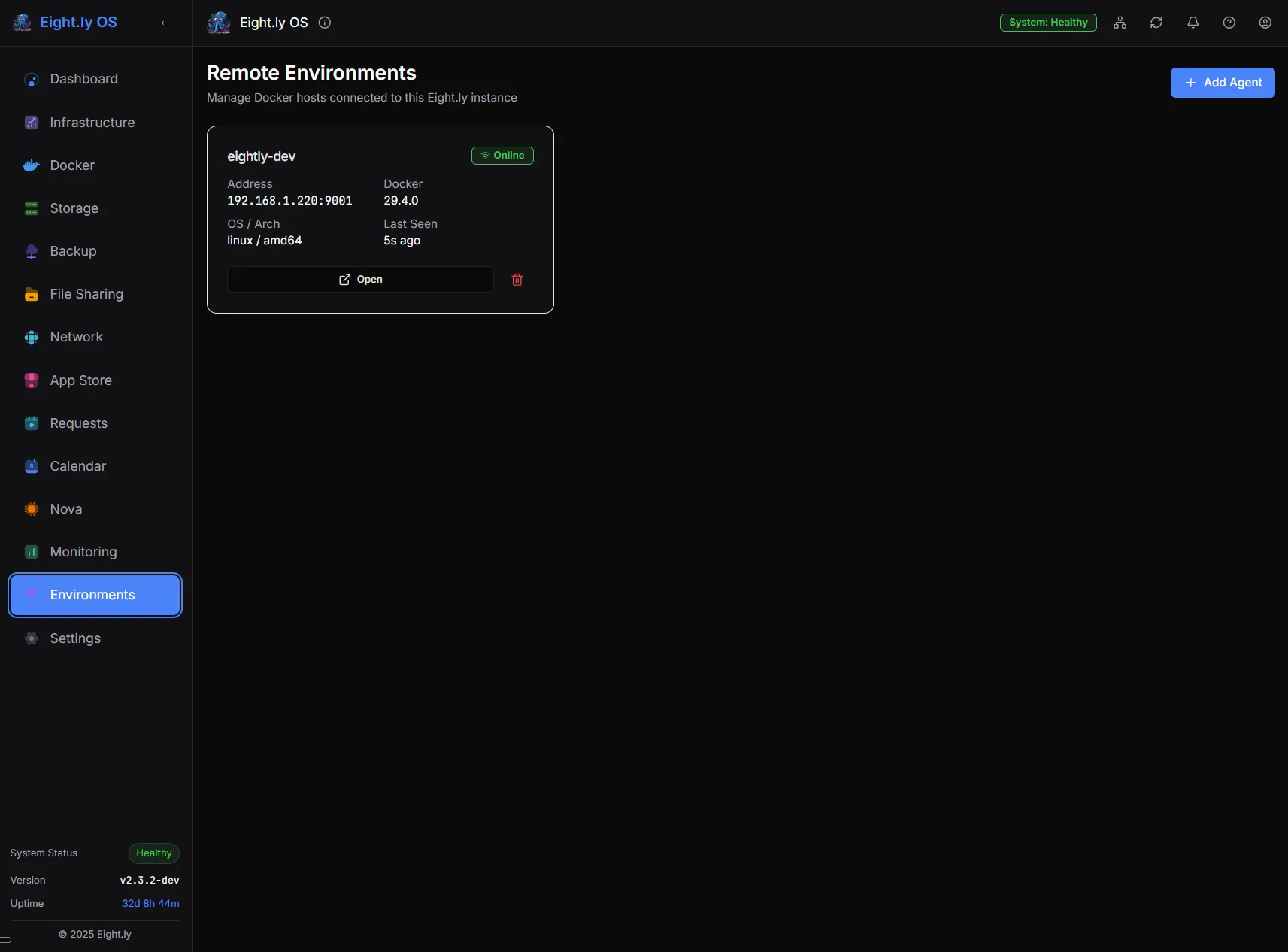
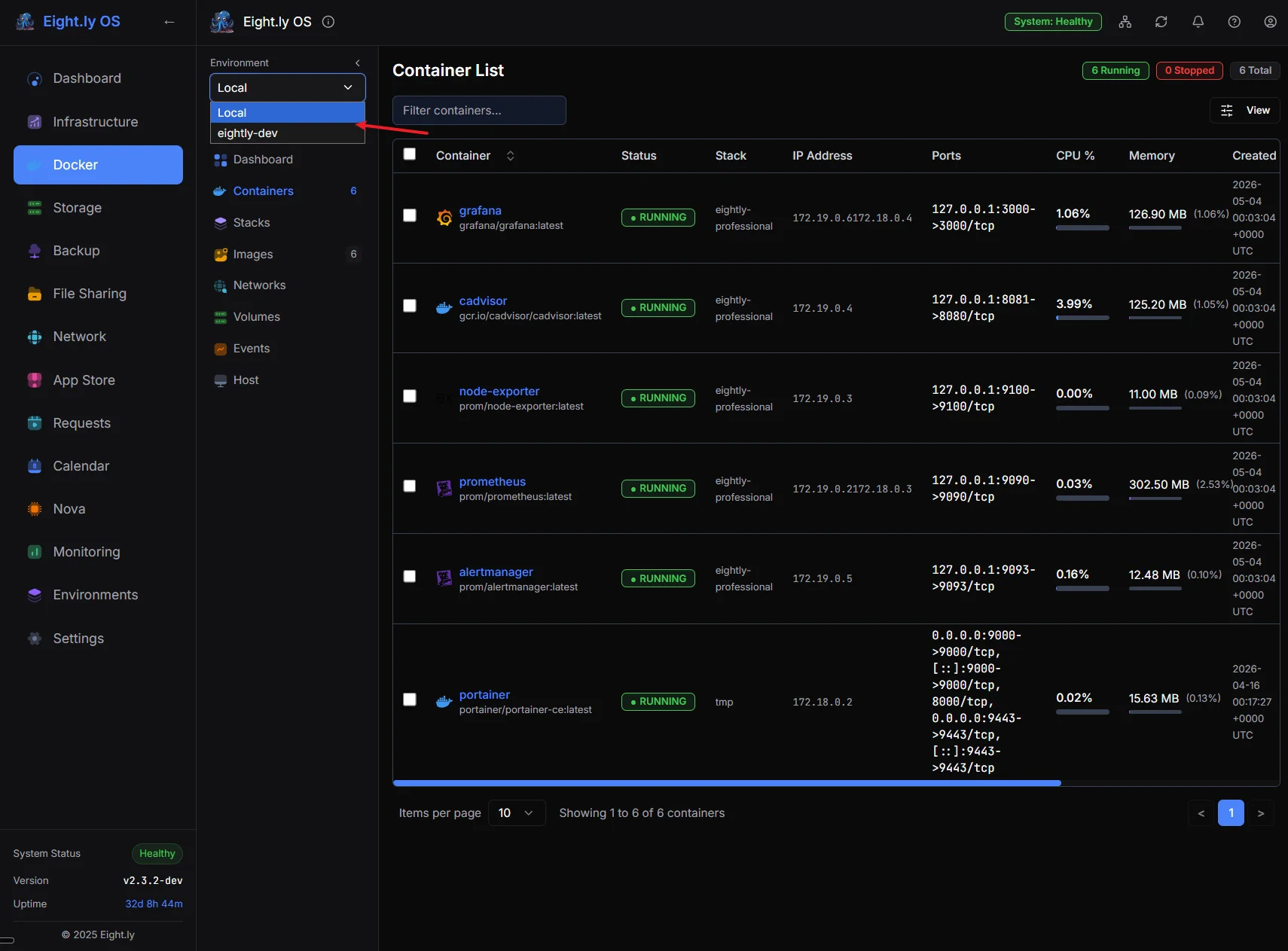
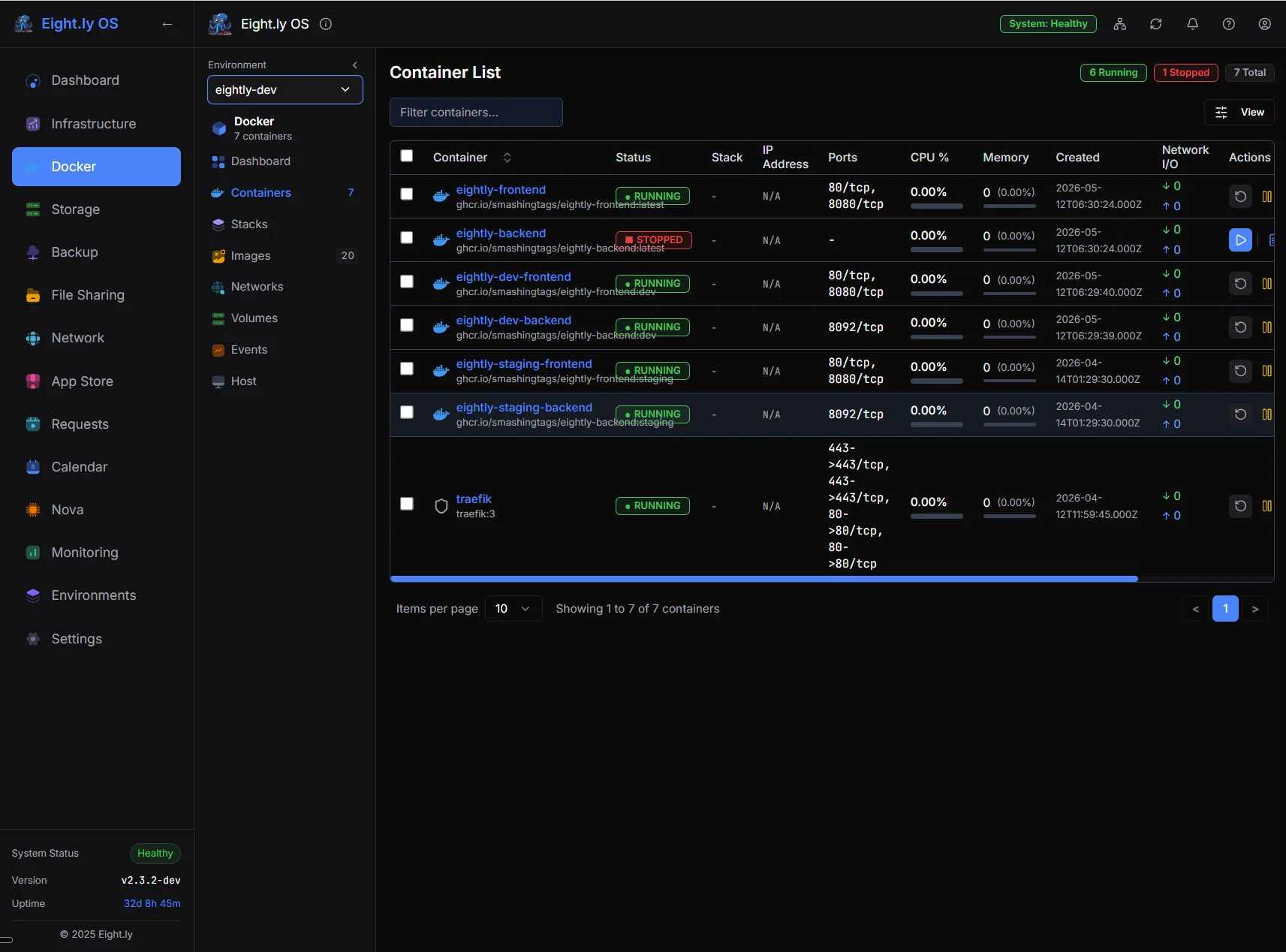
Switch between local and remote hosts from the environment dropdown. Every container, on every host, from one UI.
 |
 |
| Feature | Description |
|---|---|
| Docker API Proxy | Forwards authenticated requests on an allow-list of Docker endpoints to the local Docker socket, refusing requests that would reach the host |
| WebSocket Console | Interactive container attach and exec via WebSocket |
| File Browser | List, upload, download, delete, and rename files in Docker volumes |
| Host Info | Reports PCI devices, physical disks, and system metadata |
| Registration | Enrolls with Eight.ly OS using a one-time enrollment token and sends 30-second heartbeats |
| Auto-TLS | Serves a self-signed cert; pins the EOS server cert on first use (TOFU) |
| Prometheus Metrics | Optional /metrics endpoint for monitoring (behind --metrics flag) |
flowchart TB
    subgraph clients["Clients"]
        EOS["Eight.ly OS Dashboard"]
        CLI["curl / SDK / Mobile"]
    end

    subgraph agent["Eight.ly Agent :9001"]
        direction TB
        TLS["TLS Termination"]
        AUTH["HMAC-SHA256 Auth"]
        subgraph endpoints["Endpoints"]
            direction LR
            HEALTH["/ping /healthz /readyz /version"]
            METRICS["/metrics"]
            PROXY["Docker API Proxy"]
            WS["WebSocket Console"]
            BROWSE["File Browser"]
            HOST["Host Info"]
        end
        REG["Registration + Heartbeat"]
    end

    subgraph docker["Docker Engine"]
        SOCK["Unix Socket / Named Pipe"]
    end

    clients -->|"HTTPS + Bearer Token"| TLS
    TLS --> AUTH
    AUTH --> endpoints
    PROXY --> SOCK
    WS -->|"WebSocket"| SOCK
    BROWSE --> SOCK
    REG -->|"HTTPS"| EOS
The agent sits between the EOS dashboard and the local Docker daemon. All communication from EOS to the agent is over HTTPS with HMAC-SHA256 Bearer token authentication. The agent communicates with Docker via the Unix socket on Linux/macOS or the named pipe (//./pipe/docker_engine) on Windows.
cmd/agent/
  main.go               -- entry point, subcommands, signal handling
  healthcheck.go        -- `eightly-agent healthcheck` subcommand for container health checks
  service_windows.go    -- Windows service (install/uninstall/start/stop/status)
  service_other.go      -- stubs for Linux and macOS
internal/auth/jwt.go    -- HMAC shared-secret token validation middleware
internal/browse/        -- file browser (ls, get, put, delete, rename), confined to each volume
internal/config/
  config.go             -- CLI flags + env var parsing and validation
  secretfile.go         -- --secret-file and --enroll-token-file reading
  defaults_other.go     -- Linux/macOS default paths (unix socket, /data)
  defaults_windows.go   -- Windows default paths (named pipe, ProgramData)
internal/hostinfo/      -- PCI devices and physical disks (sysfs, system_profiler, PowerShell), cached 30s
internal/metrics/       -- Prometheus counters and gauges
internal/dockerdial/    -- connects to Docker: named pipe on Windows, Unix socket elsewhere
internal/proxy/
  routes.go             -- the allow-list of Docker methods and paths
  filter.go, policy.go  -- body, bind-root and target-container checks
  redact.go             -- environment values hidden from container inspect
  target.go             -- the same target checks for the WebSocket console
internal/register/
  register.go           -- EOS registration + 30s heartbeat loop
  renew.go              -- token renewal from half-life
  pin.go                -- first-use pinning of the EOS server certificate
  holder.go             -- registration state shared with request handlers
  statedir.go           -- state file and directory permission checks
internal/server/
  server.go             -- HTTP mux, TLS listener, registration gate, graceful shutdown
  healthcheck.go        -- health check pinned to the agent's own certificate
internal/tlsutil/tls.go -- self-signed cert generation and reuse
internal/websocket/     -- WebSocket attach + exec handlers
internal/winacl/        -- Windows access lists for the data folder, state, secret and TLS key
About 4,800 lines of Go, not counting tests.
| Module | Purpose |
|---|---|
github.com/gorilla/websocket |
WebSocket upgrade for container console |
github.com/rs/zerolog |
Structured JSON logging |
github.com/prometheus/client_golang |
Prometheus metrics exposition |
golang.org/x/sys |
Windows service management and access lists |
github.com/Microsoft/go-winio |
Docker's named pipe on Windows |
No frameworks, no ORM, no config libraries.
The GitHub wiki is generated; edit docs/wiki/ in the repository.
Getting Started
- Connect to Eight.ly OS -- From install command to an online host
- Installation -- Docker, binary, and build-from-source instructions
- Upgrading -- Upgrade steps and security changes
- Uninstall -- Remove the agent
- Configuration -- All flags and environment variables
Core Concepts
- Architecture -- Request flow, package layout, and dependencies
- Security Model -- Trust, bind roots, and network exposure
- Authentication -- HMAC-SHA256 token validation
- Registration and Heartbeat -- How agents register with EOS and maintain connectivity
- TLS -- Auto-generated certificates and custom cert support
Features
- API Reference -- Full endpoint documentation with examples
- File Browser -- Volume file management operations
- WebSocket Console -- Interactive container console access
Help
- Verifying Releases -- Checksums, signatures, provenance, and SBOM attestations
- Troubleshooting -- Common issues and debug procedures
- Development -- CI/CD and install methods
This repository will remain Apache License 2.0 in perpetuity. Future versions of the EOS protocol may be implemented in closed-source server components, but the agent itself will not change license.
Apache License 2.0 — see LICENSE for details.