


Semantic cache for AI workloads backed by Valkey vector search. Embeddings-based similarity matching with OpenTelemetry and Prometheus instrumentation.
BetterDB Monitor auto-discovers every betterdb-semantic-cache instance on your Valkey - zero configuration, the library already registers itself - and turns its stats into live dashboards:
- AI Cache & Memory - hit rate, cost saved, evictions, and index size across all your caches and memory stores, with history.
- AI Traces - OpenTelemetry waterfalls for each request, correlated with live Valkey state to explain every cache hit and miss.
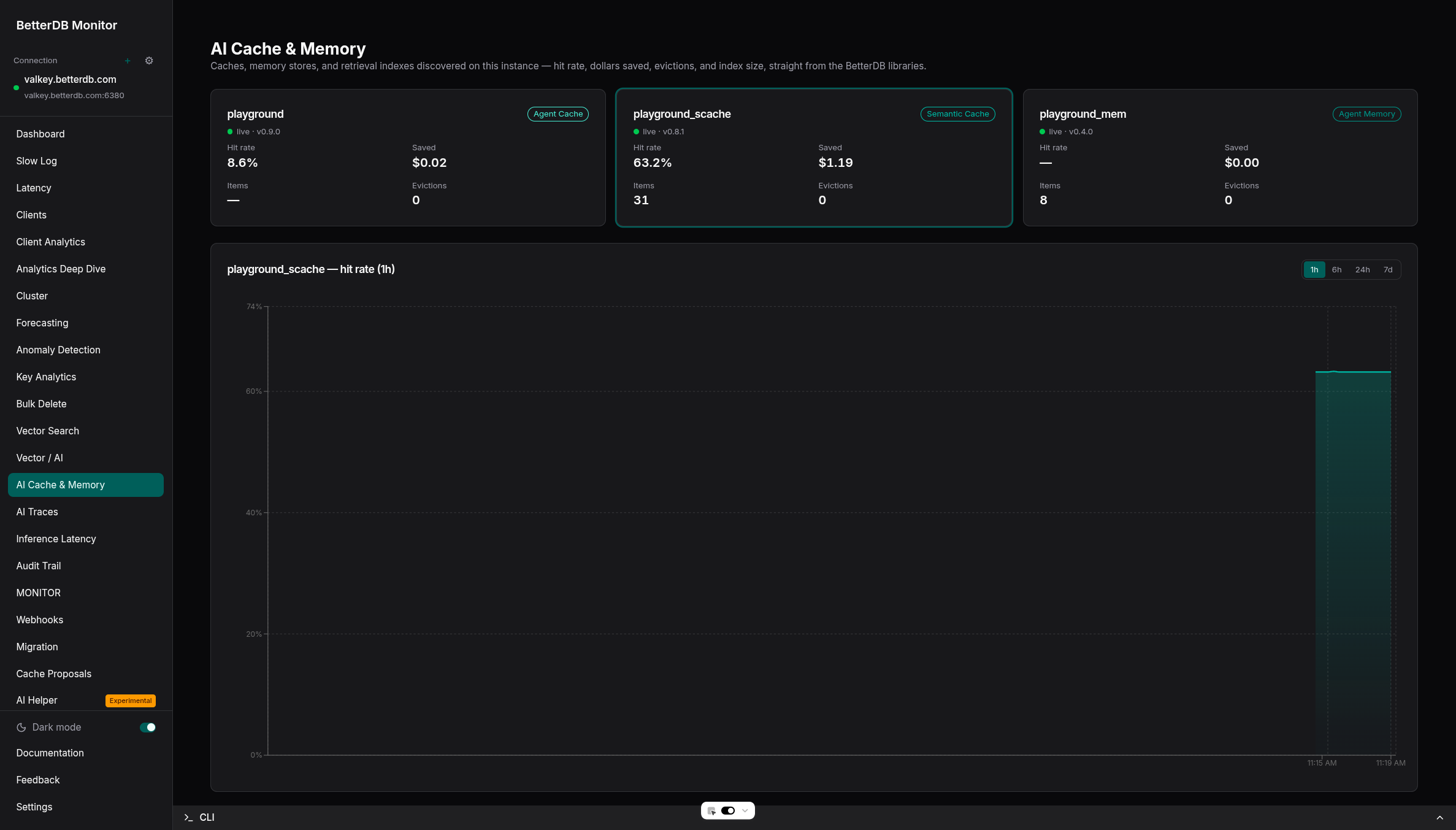
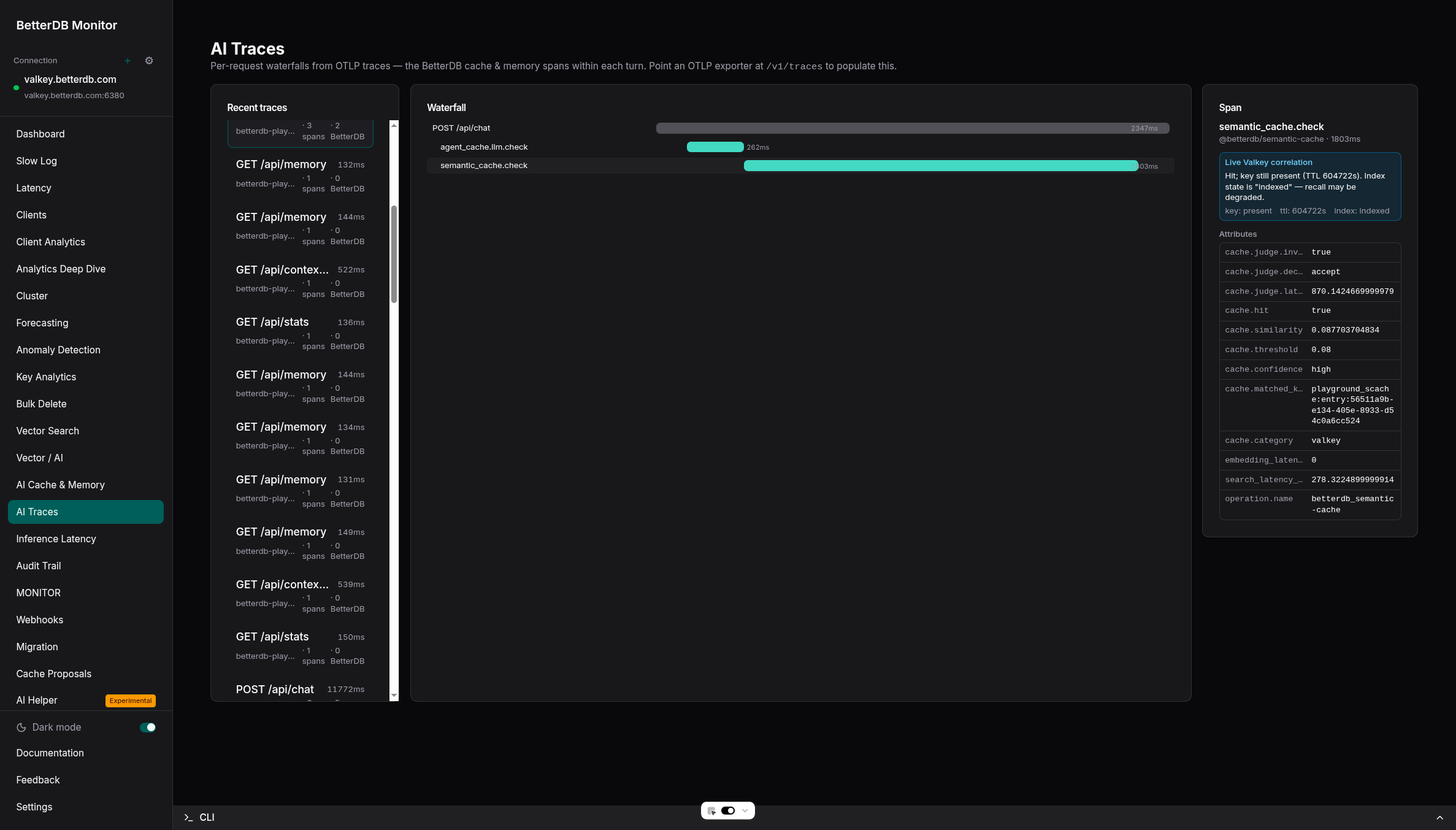
Run it self-hosted (docker run -p 3001:3001 betterdb/monitor), or use BetterDB Cloud - which can also provision a managed, TLS-enabled Valkey instance with the Search module in one click - exactly what this library needs.
pip install betterdb-semantic-cache
# With OpenAI embeddings:
pip install betterdb-semantic-cache[openai]
# All extras:
pip install betterdb-semantic-cache[all]import asyncio
import valkey.asyncio as valkey
from betterdb_semantic_cache import SemanticCache, SemanticCacheOptions
from betterdb_semantic_cache.embed.openai import create_openai_embed
async def main():
client = valkey.Valkey(host="localhost", port=6399)
cache = SemanticCache(SemanticCacheOptions(
client=client,
embed_fn=create_openai_embed(),
default_threshold=0.12,
))
await cache.initialize()
result = await cache.check("What is the capital of France?")
if not result.hit:
await cache.store("What is the capital of France?", "Paris")
asyncio.run(main())When a hit lands in the uncertainty band (threshold - uncertainty_band < score <= threshold), you can supply a judge_fn to adjudicate automatically instead of handling confidence == 'uncertain' yourself.
from betterdb_semantic_cache import JudgeOptions
from betterdb_semantic_cache.types import CacheCheckOptions

result = await cache.check(user_prompt, CacheCheckOptions(
    judge=JudgeOptions(
        judge_fn=my_judge,
        on_error="accept",   # fail-open on judge errors (default)
        timeout_ms=2000,     # per-call timeout (default)
    )
))
A minimal OpenAI judge:
from openai import AsyncOpenAI

openai = AsyncOpenAI()

async def my_judge(inp: dict) -> bool:
    # Return True to accept (confidence → 'high')
    # Return False to reject (treated as miss with nearest_miss)
    verdict = await openai.chat.completions.create(
        model="gpt-4o-mini",
        messages=[
            {"role": "system", "content": "Reply YES or NO only."},
            {"role": "user", "content": (
                f"Does this cached response correctly answer the prompt?\n"
                f"Prompt: {inp['prompt']}\nResponse: {inp['response']}"
            )},
        ],
    )
    return (verdict.choices[0].message.content or "").startswith("YES")
When the judge is invoked: only for confidence == 'uncertain' hits. High-confidence hits, misses, and the zero-candidates case bypass the judge entirely.
Accept path: result.hit == True, result.confidence == 'high'.
Reject path: result.hit == False, result.nearest_miss populated with delta_to_threshold <= 0 (use this to distinguish judge rejections from regular misses where delta_to_threshold > 0).
Composing with rerank: when both rerank and judge are set, the judge receives the reranked pick's response and similarity score.
check_batch() does not support judge. Call check() individually for prompts that need adjudication.
| Option | Type | Default | Description |
|---|---|---|---|
threshold |
float |
default_threshold |
Per-request cosine distance threshold override |
category |
str |
"" |
Category tag for per-category thresholds and metric labels |
filter |
str |
None |
FT.SEARCH pre-filter expression (trusted input only) |
k |
int |
1 |
KNN neighbours to fetch (ignored when rerank is set) |
stale_after_model_change |
bool |
False |
Evict and miss when stored model differs from current_model |
current_model |
str |
None |
Model to compare against stored entries |
rerank |
RerankOptions |
None |
Rerank hook; see RerankOptions |
judge |
JudgeOptions |
None |
LLM-as-judge for borderline hits. Not supported by check_batch(); raises SemanticCacheUsageError |
The published wheel includes anonymous product analytics powered by PostHog. When a baked API key is present in the package (injected at publish time), aggregate usage statistics (hit rate, cost saved) are collected on a per-instance basis — no prompt text, responses, or personally-identifiable information is ever sent.
To opt out, set the environment variable before starting your process:
export BETTERDB_TELEMETRY=false # also accepts: 0, no, offYou can also disable it programmatically:
from betterdb_semantic_cache.types import AnalyticsOptions
cache = SemanticCache(SemanticCacheOptions(
    ...,
    analytics=AnalyticsOptions(disabled=True),
))